

Reviewed by Dr. Amir Issa, MD, DABVLM, RPhS · CURA Vein Doctors · October 2026
You finally lie down. Your legs start aching. Why does resting make it worse? That one detail changes everything. Some causes improve the moment you get off your feet. Others get worse when gravity stops assisting blood flow to your legs. The direction of the pain points directly to the diagnosis.
Does yours improve when you lie flat, or is that exactly when it starts?
Pain in Leg When Lying Down
Leg pain when lying down has three main drivers: venous pressure that builds from prolonged standing, arterial insufficiency that worsens without gravity to assist blood flow to the feet, and nerve or muscle conditions that activate at rest. The cause determines whether lying flat relieves or worsens the pain. That difference points to the diagnosis.
Why Your Position Changes the Pain
When you stand, calf muscle contractions pump venous blood back toward the heart. Lie down, and that pump stops. For venous insufficiency, that is often good news: less hydrostatic pressure, less pooling, less aching. Elevation speeds the effect.
For peripheral artery disease (PAD), the opposite happens. Gravity normally assists arterial blood downward to the feet. Lie flat, and the feet lose that assist. The classic response: hang your feet over the edge of the bed to restore flow. That one behavior is nearly diagnostic for PAD rest pain. Neither of the leading competitor articles on this topic covers it.
Nerve pain and restless legs behave differently. They are not driven by fluid pressure. Position changes them less. What triggers them is inactivity, not orientation.
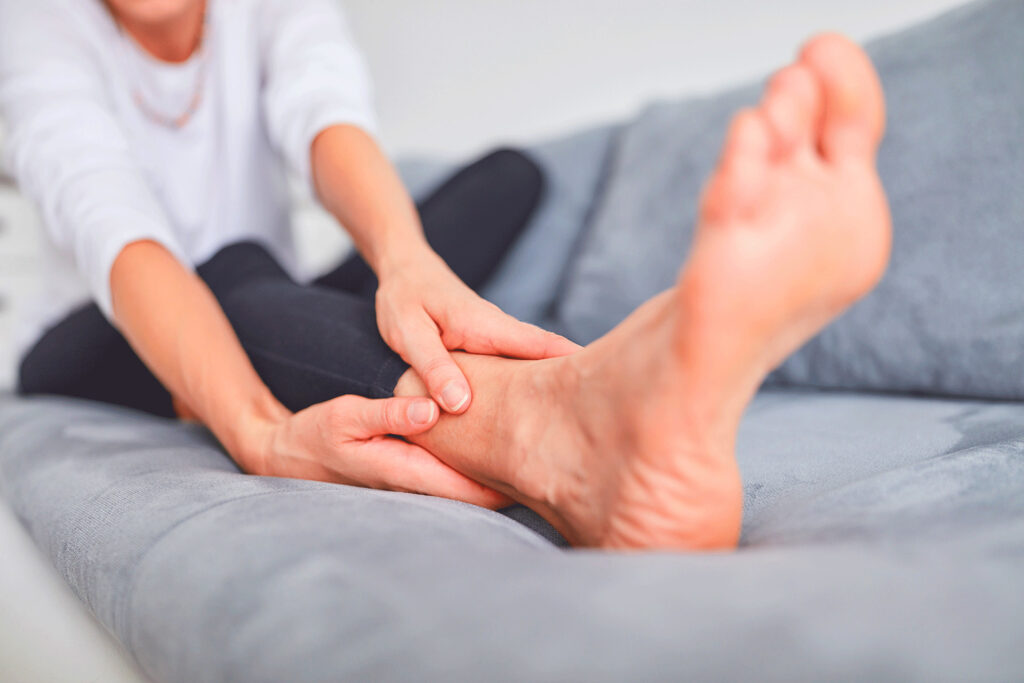
Six Causes of Leg Pain When Lying Down
Faulty vein valves let blood pool in the lower legs through the day. The result is aching, heaviness, and throbbing that peaks in the evening. Lying down with legs elevated relieves pressure quickly. If elevation does not help within 30 minutes, something else is contributing. CVI is the most common vascular cause of nighttime leg discomfort. It often runs alongside unexplained leg aching that people dismiss for years before seeking imaging.
PAD narrows the arteries supplying the legs. Mild PAD causes claudication: cramping that appears after walking a set distance and clears with rest. Severe PAD causes rest pain: burning or aching in the foot or lower calf at night, when the legs are flat and gravity can no longer assist arterial flow. Patients dangle their feet over the bed. Some sleep in a recliner to keep their feet down. An ankle-brachial index (ABI) below 0.9 confirms the diagnosis. This is the most dangerous cause on this list, and the one most commonly missed in primary care.
RLS is not classic pain. It is an irresistible urge to move the legs, accompanied by crawling or tingling discomfort. It appears at rest, peaks in the evening, and temporarily relieves with movement. Trenkwalder and colleagues identified the key associated conditions: iron deficiency, chronic kidney disease, pregnancy, and Parkinson’s disease. Serum ferritin below 75 mcg/L is a treatable driver. Dopamine agonists are first-line when iron replacement alone does not resolve it.
A sudden, involuntary contraction of the calf or foot. Unlike RLS, it is unmistakably painful and brief: seconds to a few minutes. It resolves with forced dorsiflexion (pulling the toes up toward the shin). Common triggers include dehydration, electrolyte depletion, prolonged sitting with knees bent, and medications. Statins, loop diuretics, and beta-blockers all appear on the list. Recurring cramps warrant a metabolic panel and a medication review.
Compression at L4-L5 or L5-S1 sends pain down one leg, not both. It can be burning, electric, or shooting. Lying flat may worsen lumbar spinal stenosis because spinal extension narrows the canal further. Lying with knees bent often helps. The pain does not respond to leg elevation because the cause is neural, not vascular. Pain in the left leg only, following a nerve path into the foot, is often sciatica until proven otherwise.
DVT causes unilateral calf pain, swelling, warmth, and sometimes redness. It does not reliably change with position. What distinguishes it is the asymmetry and the skin signs. A Wells score of 2 or higher places a patient in high pre-test probability territory. Same-day imaging is required. Waiting is not safe.
| Cause | Effect of lying flat | Characteristic symptom | Urgency |
|---|---|---|---|
| Venous insufficiency | Improves with elevation | Evening aching, bilateral, heaviness | Routine vascular evaluation |
| Peripheral artery disease | Worsens; relief from dangling feet | Foot or calf burning at night; claudication on walking | Urgent; ABI needed |
| Restless legs syndrome | Worsens at rest regardless of position | Urge to move; crawling sensation; bilateral | Non-urgent; treatable |
| Nocturnal cramps | No consistent position pattern | Sudden spasm; seconds to minutes; resolves with stretch | Self-care; review medications |
| Nerve compression | Varies with lumbar position | Shooting pain, one leg; follows nerve path | Non-urgent unless weakness present |
| DVT | Does not respond to elevation | Unilateral swelling, warmth, tenderness | Emergency; same-day imaging |

Pain in One Leg When Lying Down
Unilateral leg pain is more concerning than bilateral. Both legs aching after a long day points to venous load or systemic causes. One leg hurting, especially with any swelling, warmth, or skin change, shortens the differential sharply: DVT, single-limb PAD, or sciatica. The types of vein disease that affect one leg are fewer, and the dangerous ones are at the top of the list. Do not elevate and wait if the pain is new and unilateral.
What Deficiency Causes Leg Pain at Night?
Electrolyte and vitamin deficiencies drive a large share of recurrent night cramping and RLS. The table below covers the six most clinically relevant ones. Serum testing is inexpensive and often reveals a straightforward fix.
| Deficiency | Leg symptom at night | Who is at risk | How to test |
|---|---|---|---|
| Magnesium | Muscle cramps and twitching | Diuretic users, athletes, older adults, heavy alcohol use | Serum Mg; RBC Mg is more sensitive for intracellular depletion |
| Potassium | Weakness and cramps | Diuretic users, vomiting, kidney disease | Basic metabolic panel |
| Iron | Restless legs; urge to move | Women of childbearing age, pregnant, chronic kidney disease | Ferritin; target above 75 mcg/L, not just hemoglobin |
| Vitamin B12 | Burning, electric pain, foot numbness | Vegans, metformin users, older adults, gastric surgery | Serum B12; methylmalonic acid if borderline |
| Calcium | Cramping and tetany | Vitamin D deficiency, loop diuretics, hypoparathyroidism | Corrected serum calcium (adjust for albumin) |
| Vitamin D | Deep aching, diffuse muscle pain | Limited sun exposure, darker skin tones, older adults | 25-OH vitamin D |
What Actually Helps
Treatment has to match the cause. Generic advice like “stretch and drink water” helps only nocturnal cramps. It does nothing for PAD rest pain or DVT.
Venous insufficiency: elevate the legs above heart level in the evening. Wear graduated compression during the day (20 to 30 mmHg for established CVI). Walk regularly to activate the calf muscle pump. When duplex ultrasound confirms reflux, minimally invasive ablation removes the underlying cause rather than managing symptoms indefinitely.
PAD: supervised walking exercise improves collateral circulation and ABI values over 8 to 12 weeks according to TASC II guidelines. Smoking cessation is the most effective single intervention for slowing progression. Severe rest pain requires urgent vascular surgery referral. Do not elevate PAD legs; it makes rest pain worse.
Nocturnal cramps: dorsiflex the foot immediately during the episode. Between episodes, review medications with your prescriber. Magnesium glycinate before bed reduces cramp frequency in deficient patients. Quinine is no longer recommended due to cardiac arrhythmia risk.
Restless legs: check ferritin first. If below 75 mcg/L, oral iron often resolves symptoms within weeks. If ferritin is adequate, pramipexole or ropinirole are first-line. Avoid antihistamines and caffeine in the evening; both worsen RLS.
Seek same-day evaluation for any of these:
One leg swollen, warm, or red with calf tenderness: possible DVT
Foot pain at night that only eases when you dangle your legs over the bed: possible PAD rest pain
Leg weakness, foot drop, or numbness alongside pain: possible nerve compression
Leg pain after recent surgery, a long flight, or prolonged immobility: DVT risk is elevated
Chest pain or sudden shortness of breath alongside leg pain: possible pulmonary embolism

Frequently Asked Questions
When should I be concerned about leg pain at night?
Be concerned when the pain is one-sided, wakes you consistently, or does not change with elevation. Foot pain that only eases when you dangle your legs off the bed is a vascular red flag.
What are red flag symptoms of leg pain?
Unilateral swelling with warmth or redness, rest pain that worsens lying flat, and leg weakness or numbness alongside pain. Any of those warrants same-day evaluation.
What disease starts with leg pain?
PAD, chronic venous insufficiency, and DVT all present with leg pain before other signs appear. DVT can begin with nothing more than calf tenderness and mild unilateral swelling.
What deficiency causes leg pain at night?
Magnesium and iron are the most common. Magnesium deficiency drives muscle cramps; iron deficiency fuels restless legs syndrome through the dopamine pathway. A ferritin below 75 mcg/L is the treatment threshold for RLS, even without anemia.
Leg pain at night that changes with position is a signal worth following.
A duplex ultrasound rules out venous reflux and DVT in 30 minutes. If the cause is arterial, an ABI test is the next step. CURA Vein Doctors offers vein assessments covered by most major insurance when venous symptoms are affecting your sleep or daily function.
References
- Trenkwalder C, Allen R, Högl B, et al. Restless legs syndrome associated with major diseases. Neurology. 2016;86(14):1336–1343.
- Norgren L, Hiatt WR, Dormandy JA, et al. Inter-Society Consensus for the Management of Peripheral Arterial Disease (TASC II). J Vasc Surg. 2007;45(Suppl S):S5–S67.
- Butler JV, Mulkerrin EC, O’Keeffe ST. Nocturnal leg cramps in older people. Postgrad Med J. 2002;78(924):596–598.