
Reviewed by Dr. Amir Issa, MD, DABVLM, RPhS · CURA Vein Doctors · October 2026
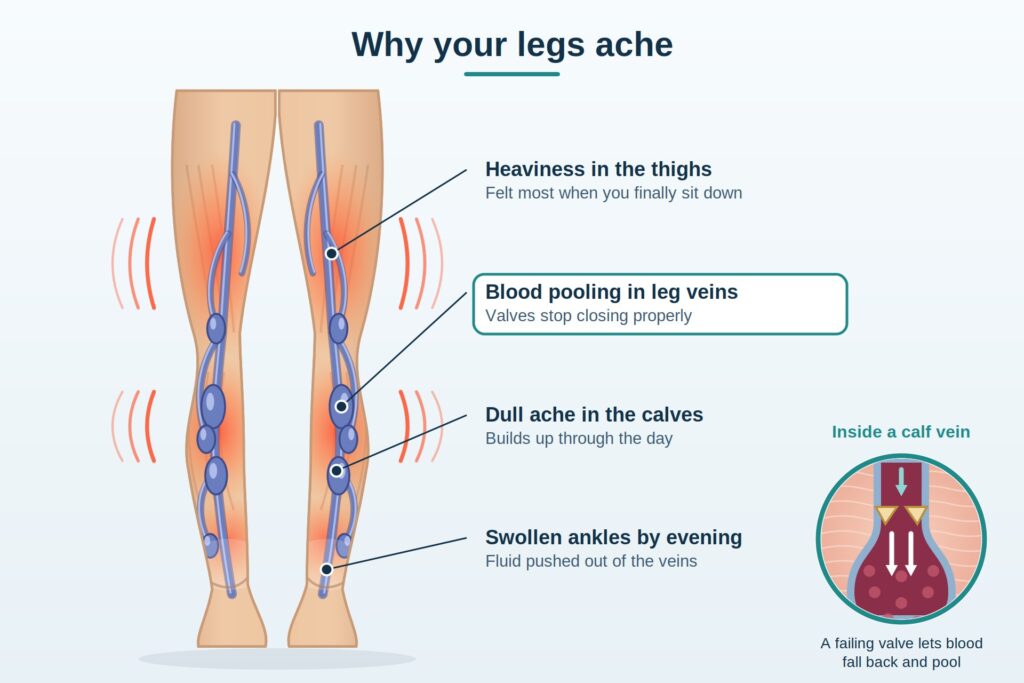
Your legs ache. You have not twisted an ankle; you have not started a new workout. The ache is just there: a dull pressure in the calves at the end of a shift, a heaviness in the thighs when you finally sit down, a soreness in the upper legs with no clear trigger. The usual answer is fatigue. Rest overnight, feel fine by morning. But when the ache keeps coming back, or when it sits in unusual places like the outer thigh or both hip girdles, fatigue is not a diagnosis. It is a placeholder.
What actually causes it? Which causes does medicine often miss? And when does it need to be checked?
What Causes Aching Legs for No Reason?
Aching legs without an obvious cause usually trace back to one of six problems: chronic venous insufficiency, where blood pools in leg veins; peripheral arterial disease; statin side effects; vitamin D deficiency; polymyalgia rheumatica; or nerve compression in the spine. The timing, location, and what relieves the ache point to the right diagnosis.
The Six Causes Behind Persistent Leg Aching
Most people who develop unexplained leg aching have something in common: a job that keeps them on their feet. A review by Waters and Dick in Rehabilitation Nursing found that 18% of standing workers had signs of chronic venous insufficiency. A Korean dataset in the same review found a varicose vein odds ratio of 7.93 in men who stood more than four hours per day. Standing is not neutral. The table below covers the six most likely causes and the clues that separate them.
| Where it hurts | Timing | What helps | Key clue |
|---|---|---|---|
| Calves and ankles | Worsens through the day; better lying down | Elevation, compression, walking | Ankle swelling by evening; skin discoloration near the inner ankle |
| Calf; thigh if artery higher up | Triggered by walking; clears in 1 to 2 minutes of standing still | Stopping activity | Many patients have only aching or fatigue, no classic cramp |
| Thighs and upper leg muscles | Often constant or worse at rest | Supervised medication review with your doctor | Started or worsened after a new prescription or dose increase |
| Hip girdle and thighs | Persistent; weakness more than pain | Vitamin D supplementation; improves in 3 to 4 weeks | Difficulty rising from a low chair; hip flexor weakness |
| Shoulders and hips, both sides equally | Morning stiffness lasting over 1 hour | Low-dose steroid within 48 hours | Adults over 50 only; responds dramatically to prednisone |
| Thighs and buttocks; above the knee | Walking triggers it; sitting or leaning forward relieves it | Seated rest; leaning forward on a trolley or rail | Comfortable on a bicycle; pain is above the knee, not in the calf |
What the Data Actually Shows
VEIN CONSULT Program: n ≈ 70,000 patients, 13 countries
- 67.3% of patients reported leg pain or aching
- 75.4% reported leg heaviness
- 58.3% said symptoms were worst at the end of the day
- 44.2% said symptoms were worst after prolonged standing
Source: Rabe E et al. Epidemiology of chronic venous disorders: results from the Vein Consult Program. Int Angiol. 2012;31(2):105-115.
Venous insufficiency is the cause most people have never heard named. The valves inside the leg veins stop closing properly, blood pools in the lower leg, and pressure builds throughout the day. It does not always come with visible varicose veins. Many patients have reflux only in the deeper veins, which are invisible from the surface. A duplex ultrasound is the only reliable way to confirm it. For a full picture of what CVI looks like at each stage, the chronic venous Insufficiency symptoms page covers the progression.
Vascular vs Neurogenic: One Distinction That Changes Everything
Both peripheral arterial disease and spinal stenosis cause leg pain with walking. Getting them confused means the wrong tests and the wrong treatment. Neurogenic claudication from spinal stenosis hurts above the knee, in the buttocks and thighs. It is relieved by sitting or leaning forward. Patients can ride a bicycle comfortably.
Vascular claudication from PAD hurts in the calf, clears by standing still, and does not allow comfortable cycling. A 2013 study by Nadeau et al. in the Canadian Journal of Surgery put the positive likelihood ratio at 13 for the full neurogenic constellation and 20 for the vascular pattern. Location is the fastest filter: above the knee points to the spine, in the calf points to the artery.
How Long Is Too Long on Your Feet?
Standing continuously for more than two hours starts affecting hip and pelvic muscles. More than three hours involves the whole lower extremity. Short seated breaks every 45 to 60 minutes reduce venous pressure peaks more effectively than compression stockings alone.
If your aching is consistently worst on workdays and eases over a long weekend, the vein valves in your legs are worth scanning.
When to Act Fast
Seek Same-Day Attention If You Have:
- Sudden swelling, warmth, or redness in one leg (possible DVT). See the blood clot symptoms page if you are unsure.
- A leg turning cold, pale, or mottled with rest pain (possible arterial occlusion)
- Jaw pain with chewing, scalp tenderness, or visual disturbance alongside hip or shoulder aching (possible giant cell arteritis)
- Bladder or bowel changes with new leg weakness or numbness (possible cauda equina)
- Dark or cola-colored urine while on statins (possible rhabdomyolysis)
What Helps and What to Do Next
Treatment only works when the cause is right. Compression stockings and leg elevation work for venous aching. A supervised medication review is needed for statin myalgia. Vitamin D supplementation resolves proximal thigh weakness in weeks. Prednisone resolves PMR within days. None of those overlap. If you have been living with aching legs for more than a few weeks without a clear cause, a duplex ultrasound rules in or out the most common one in 30 minutes. For more on the overlap between aching and the heavy-legs feeling, the heavy legs guide covers what connects and separates the two.
Frequently Asked Questions
What illness starts with achy legs?
Several conditions present with leg aching as an early symptom. Polymyalgia rheumatica begins with hip and shoulder girdle stiffness in adults over 50, while early peripheral arterial disease often causes fatigue and aching before classic cramping develops. Venous insufficiency also frequently begins as unexplained heaviness or aching well before visible veins appear.
How do I get my legs to stop aching?
The right approach depends on the cause, which is why persistent aching deserves an assessment rather than repeated painkillers. For venous aching, compression stockings, regular walking, and leg elevation bring noticeable relief within days. When the cause is statin myalgia, vitamin D deficiency, or polymyalgia rheumatica, treating the underlying condition resolves the aching within weeks.
Why do my legs constantly have a dull ache?
A dull ache that does not clear with rest usually has a structural or biochemical cause rather than simple fatigue. Venous insufficiency is the most common reason, with blood pooling raising pressure in the leg veins throughout the day. Other frequent causes are statin side effects, low vitamin D, spinal nerve compression, and, in older adults, polymyalgia rheumatica.
What is the cause of heavy aching legs?
Heavy, aching legs are the most common symptom in chronic venous insufficiency, affecting roughly three in four patients in large-scale studies. The heaviness comes from elevated venous pressure in the lower leg, which pushes fluid into the surrounding tissue and creates end-of-day swelling and fatigue. Compression hosiery, movement breaks, and, where appropriate, vein treatment significantly reduce this pattern.
To book a vein assessment at CURA Vein Doctors, visit the booking page or call +1 973-363-2029. Most assessments are covered by major insurance when venous symptoms are affecting daily function.
References
- Rabe E, Guex JJ, Puskas A, et al. Epidemiology of chronic venous disorders in geographically diverse populations: results from the Vein Consult Program. Int Angiol. 2012;31(2):105-115.
- Herrett E, Williamson E, Brack K, et al. Statin treatment and muscle symptoms: series of randomised, placebo controlled n-of-1 trials. BMJ. 2021;372:n135.
- Cholesterol Treatment Trialists’ Collaboration. Effect of statin therapy on muscle symptoms: an individual participant data meta-analysis of large-scale, randomised, double-blind trials. Lancet. 2022;400(10355):832-845.