
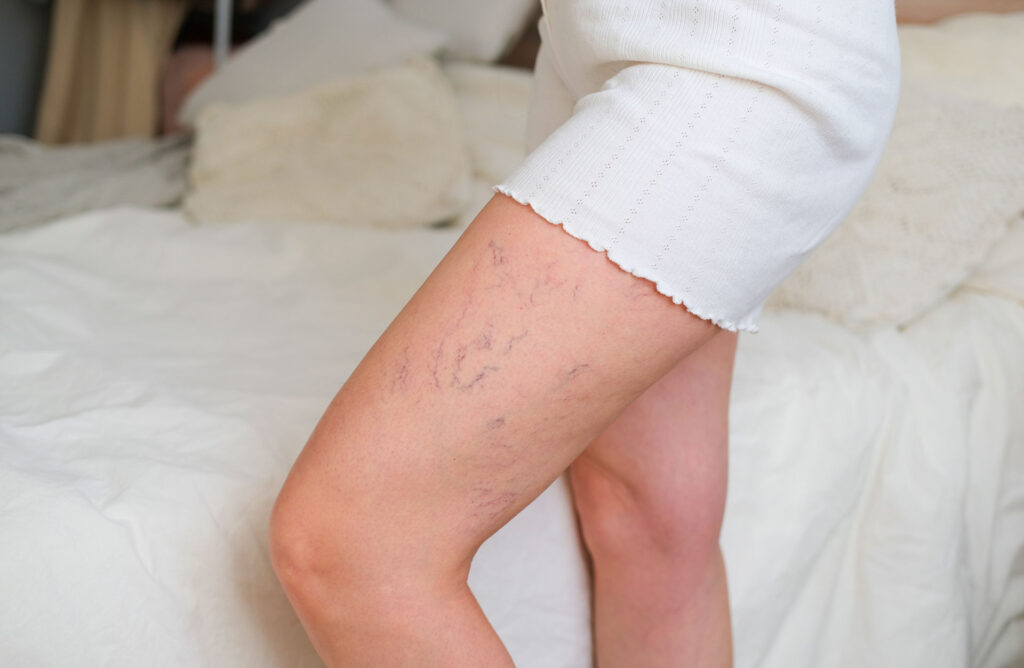
The feet are the hardest-working part of the venous system, sitting at the very bottom of a column of blood that gravity pulls downward all day long. When veins start bulging visibly across the top of the foot or around the ankle, it gets attention fast. Sometimes the explanation is straightforward. Other times it signals something that has been building beneath the surface for longer than expected.
Sudden bulging veins in feet are not always an emergency, but they are always worth understanding. The cause determines what comes next.
Why Are My Foot Veins Suddenly Bulging?
Sudden bulging veins in the feet occur when venous pressure rises above what the vein wall can contain without expanding. The most common benign triggers are prolonged standing, heat, dehydration, and exercise. Persistent or painful bulging points toward venous insufficiency, varicose veins, or thrombophlebitis, all of which benefit from specialist evaluation rather than watchful waiting.
Why the Feet Are Especially Vulnerable
The feet sit at the lowest point in the body’s venous circuit. Every time blood completes its journey downward through the legs, it has to make a full gravitational climb back to the heart. The veins across the top of the foot, the dorsal venous arch and its tributaries, bear that burden constantly whenever a person is upright.
The calf muscles assist the return journey by squeezing the deep veins with each step. When that pump stops working, through prolonged standing, inactivity, or valve failure, pressure in the foot veins climbs. The result is visible expansion. The foot has relatively little subcutaneous fat over its dorsal surface, so even modest swelling becomes apparent quickly.
Cause 1: Prolonged Standing or Sitting
Staying in a static posture for extended periods is one of the most common reasons foot veins bulge. Standing keeps gravitational pressure on the lower venous system continuously without the relief that walking and calf muscle activation would provide. Sitting with the feet on the floor does the same through a different mechanism, compressing the popliteal vein behind the knee and restricting upward flow.
This type of bulging tends to be bilateral, affecting both feet roughly equally, and it resolves within minutes of lying down and elevating the legs. When the veins return to normal at rest, the cause is almost certainly positional rather than structural.
Cause 2: Heat and Dehydration
Warm temperatures cause blood vessels to dilate as the body tries to release heat through the skin. The veins of the feet and ankles expand in response, becoming noticeably more prominent. Dehydration compounds this by reducing plasma volume, which thickens the blood and makes venous return less efficient.
Hot summer days, prolonged outdoor activity, or time spent in a sauna or hot bath can all trigger visible foot vein bulging in people who never notice their veins otherwise. The effect is temporary. Cooling down and rehydrating typically resolves it within the hour.
Cause 3: Exercise and Physical Exertion
During exercise, particularly walking, running, or cycling, blood flow to the lower limbs increases substantially. Cardiac output rises, blood pressure climbs, and the veins expand to manage the volume. The dorsal foot veins can become dramatically visible during and immediately after a workout, especially in people with a lean build or limited foot tissue depth.
This is healthy circulatory function. The veins return to their resting state within minutes. If bulging persists for hours after exercise ends, or if it is accompanied by soreness and swelling, something beyond normal exertion is at play.
Cause 4: Venous Insufficiency
Chronic venous insufficiency is the most clinically significant cause of persistent bulging veins in the feet. When the valves in the saphenous veins fail, blood accumulates progressively in the lower leg and foot. The pressure builds over months and years. Eventually the veins in the foot become visibly enlarged, not just during activity but at rest as well.
The distinguishing pattern from benign causes is persistence. These veins do not return to normal after rest. They remain prominent, and they gradually worsen. Other symptoms accompany the visibility: aching, ankle swelling that clears overnight only to return, itching near the ankle, skin discoloration, and nighttime cramps.
Cause 5: Varicose Veins Extending into the Foot
Varicose veins most commonly appear on the thigh and calf, but they can extend into the ankle and foot when the underlying insufficiency is significant. The foot veins enlarge and take on the characteristic rope-like, raised appearance of varicosities elsewhere in the leg.
These do not resolve with rest. They are structurally distorted, not just dilated in response to pressure. They may ache, especially after long periods of standing. And because the skin over the foot is thin and the veins lie close to the surface, they are at higher risk of injury and bleeding from minor trauma than varicosities higher on the leg.
Cause 6: Pregnancy
Pregnancy raises blood volume by roughly 40 to 50 percent while simultaneously compressing the pelvic veins through the growing uterus. This combination backs up venous return from both legs, raising pressure throughout the lower venous system including the feet. Foot vein bulging during pregnancy is common, particularly in the second and third trimesters.
For many women, the veins subside after delivery as blood volume normalizes. For others, especially those with a preexisting genetic tendency toward valve weakness, pregnancy accelerates permanent vein changes. Each additional pregnancy adds to the cumulative load.

Cause 7: Superficial Thrombophlebitis
When inflammation develops in a superficial foot vein alongside a small clot, the affected segment becomes red, tender, warm, and hard. This is superficial thrombophlebitis, and it feels distinctly different from ordinary vein bulging. The vein is painful to touch, the surrounding skin is often reddened, and the presentation typically develops quickly over hours rather than gradually over months.
Most superficial thrombophlebitis cases are not dangerous, but they warrant assessment. A clot close to the junction between superficial and deep veins can extend into the deep system, which is a more serious situation. When such intense, localized foot pain does not improve with standard vascular care, clinicians often differentiate between vascular and nerve-based treatments by weighing DRG stimulation vs. spinal cord stimulation.
Benign vs. Concerning: How to Read Your Foot Veins
| Pattern | Likely Explanation | What to Do |
|---|---|---|
| Veins bulge during standing, resolve with elevation | Positional venous pressure | None needed |
| Veins visible in heat or after exercise, clear quickly | Temperature dilation or exertion | None needed |
| Veins prominent during pregnancy, no symptoms | Elevated blood volume | Monitor, mention to OB |
| Same foot veins persistently raised, worsening over months | Venous insufficiency | Schedule vein consultation |
| Raised veins with aching, ankle swelling, skin changes | Varicose veins or CVI | Schedule vein consultation |
| Red, tender, warm, hard vein segment on foot | Superficial thrombophlebitis | See a doctor within days |
| Sudden one-sided swelling, warmth, calf or foot pain | Possible deep vein thrombosis | Same-day evaluation |
Managing Bulging Foot Veins: What Actually Helps
For benign causes, the following measures reduce pressure and improve comfort:
- Leg elevation for 15 to 20 minutes after long periods of standing or sitting, with feet above heart level
- Medical-grade compression stockings, worn from the morning before standing, not added at the end of the day when swelling has already developed
- Short walking breaks every 45 to 60 minutes to activate the calf muscle pump
- Adequate hydration throughout the day, particularly in warm weather
- Avoiding prolonged standing in one position, shifting weight and moving where possible
For venous insufficiency and varicose veins extending into the foot, conservative measures manage symptoms but do not correct the underlying valve failure. Minimally invasive procedures including endovenous laser ablation, radiofrequency ablation, and sclerotherapy close the diseased veins and remove the source of the pressure. Most are performed in an outpatient setting under local anesthesia, with same-day recovery. For cases where foot pain persists despite addressing vascular pressure, specialists may pivot to neurological diagnostics like peripheral nerve stimulation for chronic pain.
Frequently Asked Questions
Why Are My Foot Veins Suddenly Bulging?
Sudden foot vein bulging that resolves with rest usually reflects positional pressure from prolonged standing, heat, or dehydration. Sudden bulging that persists, appears in one foot only, or comes with pain and warmth needs evaluation. The first scenario is benign physiology. The second can indicate venous insufficiency, thrombophlebitis, or in rare cases deep vein thrombosis.
Can You Reverse Bulging Veins Naturally?
Structurally distorted varicose veins cannot reverse naturally once valve damage has occurred. Compression stockings, leg elevation, and regular exercise reduce symptoms and slow progression, but they do not restore valve function or shrink enlarged veins. Minimally invasive procedures close the diseased vein permanently, which is the only way to resolve the structural problem at its source.
Is It Normal to Have Bulging Veins in Your Feet at a Young Age?
Yes, it can be normal. Low body fat, athletic training, heat, and prolonged standing all cause foot veins to bulge at any age. However, persistent visible veins in a young person, especially with symptoms, can indicate an early-onset genetic predisposition to venous insufficiency. A duplex ultrasound quickly confirms whether valve function is normal.
When Should I Worry About Veiny Feet?
Worry is warranted when the veins stay persistently prominent regardless of position or temperature, when they are accompanied by aching, ankle swelling, or skin changes, or when a specific vein segment becomes red, tender, and hard. Sudden swelling in one foot with calf pain needs same-day assessment to rule out deep vein thrombosis.
When to Worry About Bulging Veins?
Bulging veins that appear bilaterally after standing or in heat are generally benign. Concern rises when bulging is unilateral, persistent, painful, accompanied by swelling or skin discoloration, or when a vein segment becomes inflamed and cord-like. Any combination of leg swelling, warmth, and tenderness appearing suddenly in one limb warrants same-day medical evaluation.
Should You See a Doctor for Bulging Veins in Your Legs?
Yes, if the veins are persistent, symptomatic, or accompanied by skin changes. A vein specialist can perform a duplex ultrasound, which takes around 30 minutes and is painless, to determine whether valve function is compromised. Early evaluation prevents the condition from advancing to the skin-damage and ulceration stages, which are harder and more expensive to treat.
Do Bulging Foot Veins Mean Heart Problems?
Bulging foot veins are very rarely a sign of heart problems. They almost always reflect local venous insufficiency, positional pressure, or benign circulatory physiology. Heart failure can cause lower-leg swelling that makes veins more prominent, but this is accompanied by other clear signs like breathlessness, bilateral pitting edema, and fatigue. Isolated foot vein bulging without these signs points to venous rather than cardiac causes.