
Reviewed by Dr. Amir Issa, MD, DABVLM, RPhS · CURA Vein Doctors · Updated September 2026
Blood is red. Every biology class, every blood drive, every scraped knee confirms it. So why do the veins running under your skin look blue, sometimes even green? The answer isn’t about your blood changing color at all.
Why Are We Taught Blood Is Blue?
The myth
Many people learn in school that deoxygenated blood is blue, largely because textbook diagrams color veins blue and arteries red for easy visual distinction, not because it’s biologically accurate. Blood donation bags, anatomy charts, and early medical illustrations reinforced this color-coding convention, and the shorthand stuck as a widely believed “fact” that simply isn’t true.
What Color Is Human Blood?
The fact
Human blood is always some shade of red, never blue, at any point in the body. Oxygen-rich blood leaving the heart is bright cherry-red, while oxygen-depleted blood returning through the veins is a darker maroon-red. The color comes from hemoglobin, the iron-containing protein in red blood cells that binds to oxygen.
Why Do Veins Look Blue If Blood Is Red?
The science
Skin scatters light by wavelength, a principle called Rayleigh scattering, the same physics that makes the sky blue. Blue light penetrates only about 1 millimeter into skin and scatters back toward your eyes, while red light travels 4 to 5 millimeters deep enough to reach a vein and get absorbed by hemoglobin instead of reflecting back.
With less red light bouncing back from directly above a vein, your brain perceives that spot as relatively more blue, even though the blood underneath never stopped being red.
Are Veins Blue or Red?
| Feature | Arterial Blood | Venous Blood |
|---|---|---|
| Actual color | Bright cherry-red | Darker maroon-red |
| Oxygen level | High | Lower |
| Direction | Away from the heart | Back toward the heart |
| Appearance through skin | Rarely visible, arteries sit deeper | Often visible, appears blue or green |
Veins are red on the inside and only ever appear blue from the outside, and even that varies by person. Thinner skin, less body fat, and veins sitting closer to the surface all make them more visible. Vein depth also shifts the exact shade; a vein closer to the surface may look more green, since some red light still makes it back alongside the scattered blue. On deeper skin tones, veins often appear green or dark brown rather than blue, or may not stand out distinctly at all.

Cyanosis: When Blue Skin Actually Is a Concern
There’s one genuine exception to all of this. Cyanosis is a real medical condition where skin, lips, or fingertips turn bluish because blood oxygen levels have dropped significantly, unlike normal veins, which look blue purely from light scattering regardless of oxygen level. Cyanosis typically affects a wider area than a single vein, comes on with other symptoms like shortness of breath, and needs prompt medical attention. A single blue-looking vein on an otherwise healthy leg is not cyanosis.
When Should You See a Doctor of Veins About Visible Veins?
See a doctor of veins if a visible vein is bulging, twisted, painful, or comes with symptoms that build through the day, heaviness, aching, swelling around the ankle, or a throbbing or burning sensation near the vein. This discomfort isn’t always constant either; vein-related pain can come and go, flaring after long periods of standing or sitting rather than staying steady. These patterns point to an underlying vein condition rather than normal light physics, and they’re the same signs vein specialists look for when evaluating chronic venous insufficiency. Color alone is never the concern; a vein specialist looks at shape, symptoms, and function instead
If It Is a Vein Problem, What Happens Next?
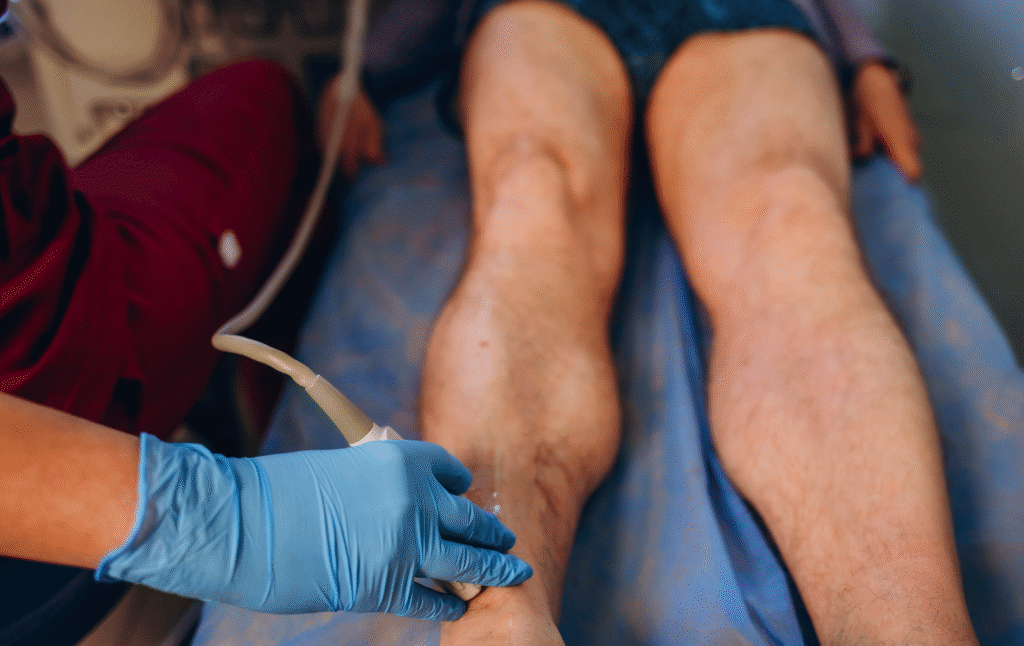
When a visible vein does turn out to be more than an optical effect, treatment closes the problem vein so blood reroutes through healthier ones nearby. Common options include sclerotherapy for smaller veins, endovenous ablation for larger diseased veins, and VenaSeal for patients who’d rather skip the numbing injections. A vein specialist matches the option to what your ultrasound actually shows.
Frequently Asked Questions
Why are we taught blood is blue?
It comes from textbook color-coding, blue for veins and red for arteries, used to make diagrams easier to read, not because deoxygenated blood is actually blue.
What color is human blood?
Blood is always red, ranging from bright cherry-red when oxygen-rich to a darker maroon-red when oxygen-depleted. It’s never blue inside the body.
Are veins blue or red?
The blood inside veins is red. They only appear blue or green from outside the skin due to how light scatters and gets absorbed at different wavelengths.
A visible vein that’s more than just an optical trick of light deserves a real look. Call CURA Vein Doctors at +1 973-363-2029 or use the contact page to get it evaluated.
References
- Visual Appearance of Blood Vessels: A Phantom Study. National Library of Medicine. ncbi.nlm.nih.gov/pmc/articles/PMC12904536
- Cleveland Clinic. What Color Is Blood? health.clevelandclinic.org/what-color-is-blood