
Reviewed by Dr. Amir Issa, MD, DABVLM, RPhS · CURA Vein Doctors · October 2026
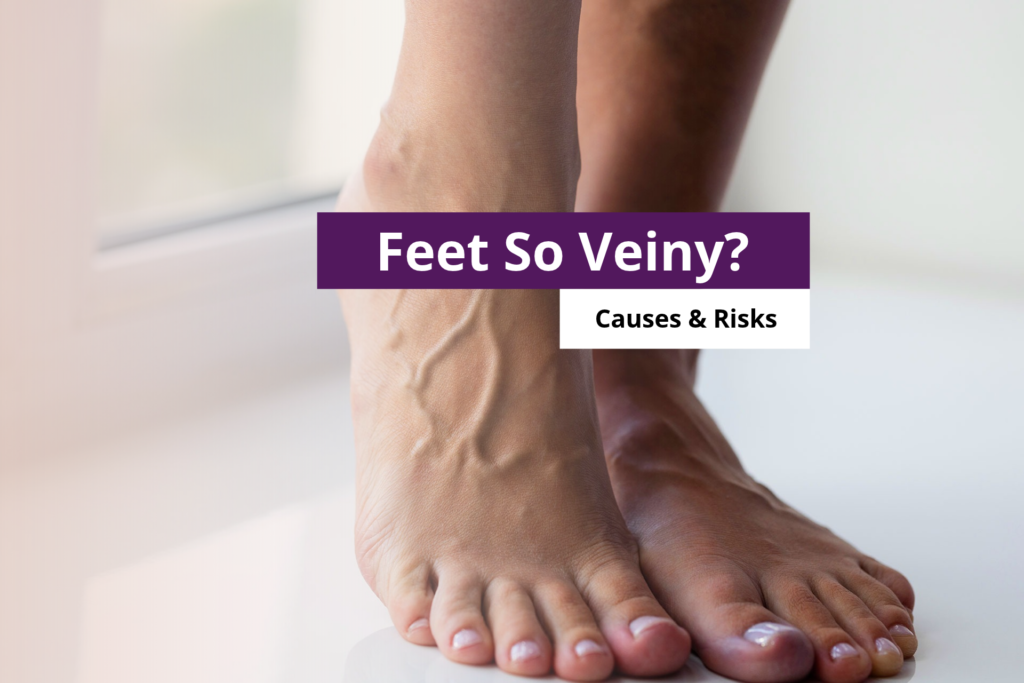
The veins crossing the tops of your feet are not always a warning sign. But they are not always nothing, either. They can mark the beginning of chronic venous insufficiency, a condition affecting roughly 40% of adults at some point. What separates a harmless anatomy trait from a vein problem worth treating?
Why Are My Feet So Veiny?
In Brief
Feet have almost no subcutaneous fat to conceal veins, so healthy vessels look prominent even in young, fit people. Low body fat, heat, exercise, and genetics explain most cases. When foot veins appear suddenly, bulge visibly, or cause symptoms, chronic venous insufficiency or deep vein thrombosis may be the underlying cause.
The foot contains a dense network of superficial and deep veins. Because the overlying skin is thin and the fat layer is minimal, even normal-caliber vessels stand out clearly. Temperature, fitness level, age, and heredity all affect how visible those veins look from day to day.
Benign Causes vs. Causes That Warrant Evaluation
Most visible foot veins fall into the benign column. A smaller subset signals an underlying vein disease that looks similar on the surface but behaves very differently without treatment.
| Cause | Category | Symptoms Beyond Appearance | Specialist Needed? |
|---|---|---|---|
| Low body fat or lean build | Benign | None | No |
| Heat exposure or exercise | Benign | None | No |
| Age-related skin thinning | Benign | None | No |
| Genetics and family history | Benign predisposition | Mild aching possible | Optional |
| Pregnancy | Temporary | Heaviness, swelling | Monitor |
| Chronic venous insufficiency | Pathological | Aching, swelling, skin changes | Yes |
| Varicose veins with valve reflux | Pathological | Throbbing, heaviness after standing | Yes |
| Deep vein thrombosis (DVT) | Urgent | Sudden swelling, warmth, redness in one leg | Same day |
| Peripheral artery disease | Pathological | Cramping with walking, cold or pale feet | Yes |
Warning Signs That Need Prompt Evaluation
See a Vein Specialist If You Notice These Signs
One foot more swollen than the other
Skin around the ankle turns brown or leathery
A vein appears suddenly and hurts to the touch
Swelling that does not resolve overnight with foot elevated
Open sores or ulcers near the ankle
A vein that feels hard, hot, or cord-like under the skin
These signs point to chronic venous insufficiency or deep vein thrombosis, and often overlap with chronic pain warning signs that are easy to dismiss. Neither condition resolves on its own. A duplex ultrasound (painless, no radiation, same-day results) confirms or rules out both within 30 minutes at a vein specialist’s office.
Treatment Options for Veiny Feet
The right procedure depends on vein size, whether valve reflux is present on ultrasound, and whether the case is cosmetic or symptomatic. There is no one-size-fits-all answer.
| Procedure | Best For | Session Length | Return to Activity |
|---|---|---|---|
| Sclerotherapy | Spider veins and small varicosities | 15–30 min | Same day |
| Endovenous laser ablation (EVLA) | Large incompetent veins with confirmed reflux | 45–60 min | Next day |
| Radiofrequency ablation (RFA) | Large incompetent veins with confirmed reflux | 45–60 min | Next day |
| Microphlebectomy | Bulging surface varicose veins | 30–60 min | 1–3 days |
All four procedures are performed in-office under local anesthesia. Sclerotherapy is first-line for spider veins; endovenous ablation is indicated only when ultrasound confirms valve failure. EVLA and RFA carry success rates above 95% at one year.
What to Do Before Your Appointment
Elevate
Keep feet above heart level for 20 minutes, twice daily. Reduces pooling and overnight aching.
Walk
20 minutes daily activates the calf muscle pump, the most powerful venous return mechanism in the leg.
Compress
Graduated compression at 20–30 mmHg controls swelling and slows progression during long periods of standing.
These measures reduce discomfort; they do not reverse valve damage already present. Adding anti-inflammatory foods to your diet provides complementary support between visits.

Frequently Asked Questions
Will insurance pay for vein removal?
Insurance covers vein treatment when it is medically necessary. That requires documented symptoms such as pain, swelling, or skin changes, plus ultrasound-confirmed valve reflux. Purely cosmetic treatment of asymptomatic veins is rarely covered.
Is vein removal worth it?
For veins causing aching, heaviness, or skin changes, yes. Endovenous ablation carries a success rate above 95% and prevents progression to ulceration. For cosmetic-only cases, the decision is personal since insurance typically does not apply.
How serious is vein ablation?
It is a low-risk, office-based procedure performed under local anesthesia. The most common side effects are minor bruising and temporary numbness along the treated vein. Serious complications occur in fewer than 1% of cases.
What happens if I cut a vein on my foot?
Apply firm, direct pressure with a clean cloth for 10 to 15 minutes without lifting to check. Elevate the foot above heart level. If bleeding does not slow or is heavy, go to an emergency room; foot veins bleed more heavily when varicose veins are involved, since gravity maintains pressure in the vessel.
Veiny Feet? Find Out What Is Behind Them.
CURA Vein Doctors offers same-day duplex ultrasound evaluation. Know whether your foot veins are harmless or require treatment.
References
- Eberhardt RT, Raffetto JD. Chronic venous insufficiency. Circulation. 2014;130(4):333–346.
- Gloviczki P, Comerota AJ, Dalsing MC, et al. The care of patients with varicose veins and chronic venous disease. J Vasc Surg. 2011;53(5 Suppl):2S–48S.
- Rabe E, Guex JJ, Puskas A, Scuderi A, Fernandez Quesada F. Epidemiology of chronic venous disorders in geographically diverse populations. Int Angiol. 2012;31(2):105–115.