
Reviewed by Dr. Amir Issa, MD, DABVLM, RPhS · CURA Vein Doctors · October 2026
Up to one in three women develops varicose veins during pregnancy. For most, they cause discomfort rather than danger. But the line between normal venous swelling and a developing clot is thinner than most patients expect. What follows gives you the full picture: the biology, the red flags, and what actually happens after you deliver. So when does a bulging vein become an emergency?
What Are Varicose Veins During Pregnancy?
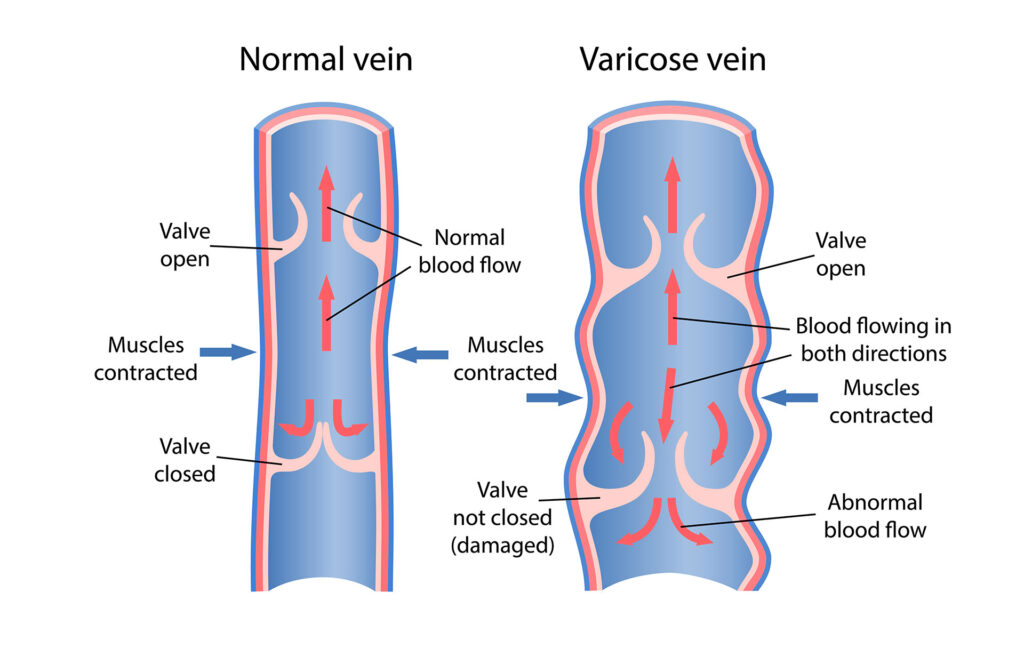
Varicose veins are enlarged, twisted vessels that form when vein valves fail and blood pools instead of flowing upward to the heart. Pregnancy affects varicose veins on multiple fronts, making the legs, inner thighs, and sometimes the vulva susceptible from the first trimester onward.
Thing 1: Why Pregnancy Causes Varicose Veins
Blood volume increases by 40–50% to supply the placenta, raising pressure in every vessel. Progesterone then relaxes vein walls, reducing their elasticity. On top of that, the uterus eventually compresses the inferior vena cava and iliac veins (the main drainage channels from the legs), forcing smaller surface veins to handle the overflow.
| Risk Factor | Why It Increases Your Risk |
|---|---|
| Family history of varicose veins | Inherited weakness in vein valve structure |
| Multiple pregnancies | Cumulative valve strain worsens with each pregnancy |
| Prolonged standing or sitting at work | Gravity amplifies venous pooling in the lower legs |
| Pre-existing overweight | Greater abdominal mass presses harder on pelvic drainage veins |
| Carrying multiples (twins, triplets) | Higher blood volume and a larger uterus compress pelvic vessels sooner |
| Advanced maternal age | Vein wall elasticity declines naturally after the mid-30s |
Thing 2: Where They Appear (and What They Feel Like)
The back of the knee, inner calf, and thigh are the most common locations. Venous pooling behind the knee can also cause knee stiffness alongside visible vein bulging. Varicosities can also appear on the vulva (15–20% of affected women), inner thighs, and buttocks, areas that rarely develop them outside pregnancy. Symptoms include a heavy or achy leg feeling that worsens by late afternoon, itching or burning along a vein, visible rope-like bulges, and ankle swelling that eases overnight with elevation.
Vulvar varicosities cause perineal heaviness and pressure, most noticeable in the third trimester. They almost always resolve within two to four weeks after delivery. A maternity compression support band worn from the second trimester onward helps manage discomfort until then.
Thing 3: Symptoms That Signal DVT or an Emergency
Pregnancy raises DVT risk five to ten times above baseline, and a clot that travels to the lungs becomes a pulmonary embolism. Any of the six signs above warrants same-day evaluation, not a wait-and-see approach. A duplex ultrasound, safe at all stages of pregnancy, rules out DVT within minutes at a vein specialist’s office.
Thing 4: How to Reduce Discomfort and Slow Progression
No medication reverses varicose veins safely during pregnancy. Several evidence-backed measures do reduce symptoms and slow deterioration.
| Compression Class | Pressure Range | Typical Use in Pregnancy |
|---|---|---|
| Class 1 / Mild | 15–20 mmHg | Prevention, mild swelling, daily wear |
| Class 2 / Moderate | 20–30 mmHg | Established varicosities; most clinical guidelines recommend this range |
| Class 3 / Firm | 30–40 mmHg | Physician-prescribed only; not for routine self-use |
Put stockings on before getting out of bed, when veins are least engorged. Walk 20–30 minutes daily, elevate your legs above hip level twice a day, sleep on your left side to keep the uterus off the vena cava, and add anti-inflammatory foods such as leafy greens, berries, and omega-3-rich fish. Avoid staying in one position for more than 45 minutes.
Sclerotherapy, laser ablation, and radiofrequency ablation are effective but deferred until after delivery and, if applicable, after breastfeeding ends. Planning your post-delivery treatment now means you start the moment your clinician clears you.
Thing 5: What Happens to Varicose Veins After You Give Birth?
What to Expect After Delivery
wks
6 Weeks
Blood volume normalizes; superficial veins begin visibly fading
mo
3 Months
Many varicosities show significant reduction or disappear entirely
mo
6 Months
Residual veins assessed; treatment planning begins if needed
mo
12 Months
Persistent veins treated with sclerotherapy, laser, or ablation
Studies estimate 30–70% of pregnancy-related varicose veins improve significantly within three to twelve months after delivery. Veins that persist beyond twelve months rarely resolve without treatment. Continue compression stockings through the six-week postpartum check; DVT risk remains elevated during this window. Sclerotherapy and other chemical treatments are deferred while breastfeeding.
Frequently Asked Questions
When to worry about varicose veins during pregnancy?
Seek same-day evaluation for one leg more swollen than the other, warmth or redness over a vein, sudden shortness of breath, or chest pain. These can signal deep vein thrombosis or pulmonary embolism, which carry five to ten times the normal risk during pregnancy. A vein that ruptures and won’t stop bleeding also warrants urgent care.
Do varicose veins from pregnancy go away?
Many do. Studies show 30–70% improve or disappear within three to twelve months as blood volume normalizes and progesterone falls. Veins that persist beyond twelve months are unlikely to resolve on their own and are candidates for minimally invasive treatment.
Why did I get varicose veins when pregnant?
Three forces combine: blood volume rises 40–50%, progesterone relaxes vein walls, and the growing uterus compresses the main pelvic drainage veins. Genetics matters too. If a parent had pregnancy varicosities, your risk is substantially higher.
Can I stop the progression of varicose veins?
You can slow it considerably. Graduated compression at 20–30 mmHg is the most evidence-supported option during pregnancy. Daily walking, leg elevation, and left-side sleeping all limit how far the veins advance before delivery.
Ready to Treat Pregnancy Varicose Veins After Delivery?
CURA Vein Doctors specializes in minimally invasive vein treatment for women at every stage. Plan your post-delivery consultation today.
References
- James AH. Venous thromboembolism in pregnancy. Arterioscler Thromb Vasc Biol. 2009;29(3):326–331.
- Beebe-Dimmer JL, Pfeifer JR, Engle JS, Schottenfeld D. The epidemiology of chronic venous insufficiency and varicose veins. Ann Epidemiol. 2005;15(3):175–184.
- Tisi PV. Varicose veins. BMJ Clin Evid. 2011;2011:0212.